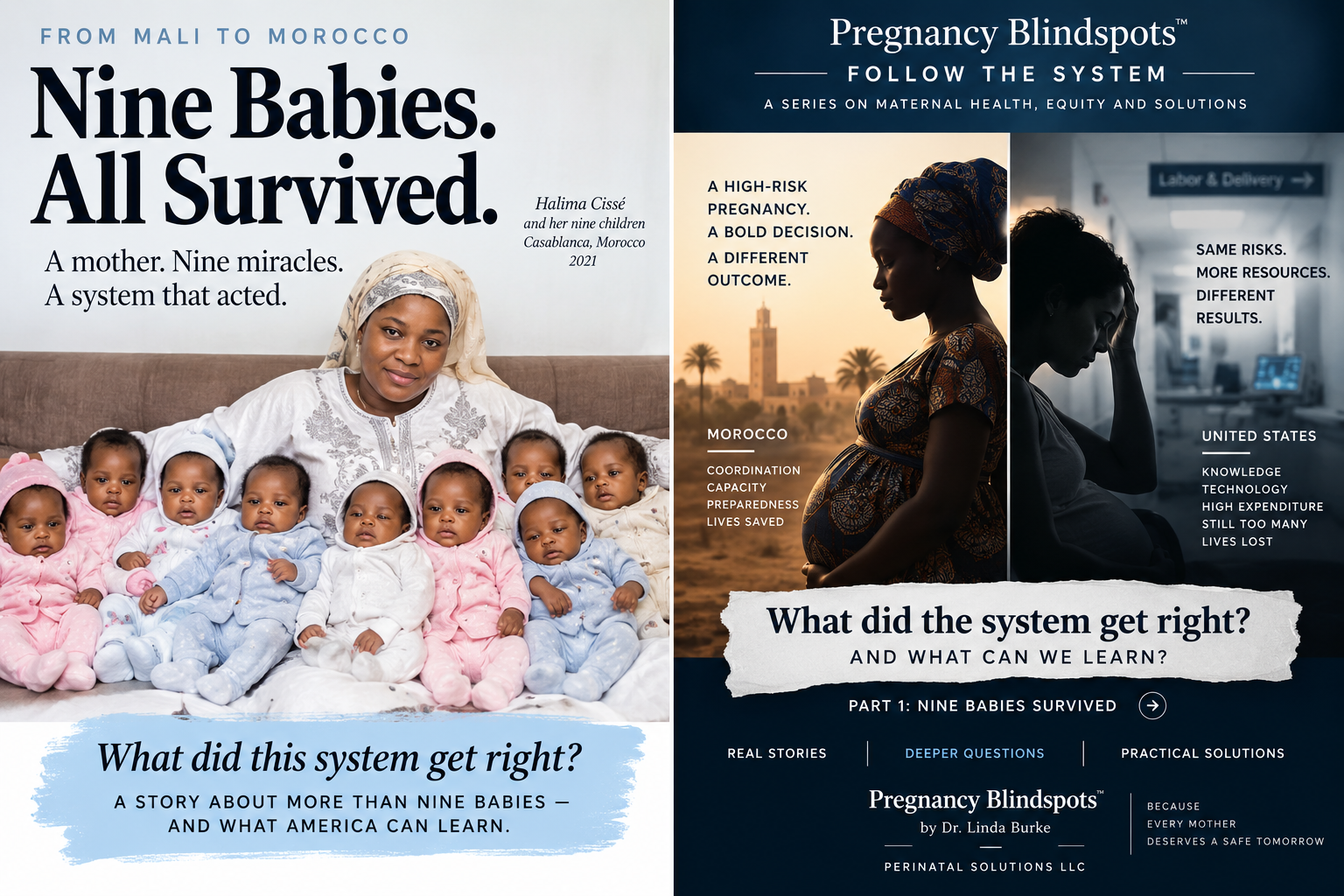

When I first saw a photograph of Halima Cissé surrounded by her nine children, I thought it might have been created by artificial intelligence.
It wasn’t.
In 2021, Cissé, a young woman from Mali, gave birth to nine babies in Casablanca, Morocco. Five girls. Four boys. All nine survived. So did their mother.
As an OB-GYN, what amazed me was not simply that nine babies were born.
It was that a pregnancy this dangerous did not end in catastrophe.
This Was Not an Easy Birth
Cissé’s outcome was not the result of luck or an uncomplicated pregnancy.
She was transferred from Mali to Morocco for specialized care. She was admitted at approximately 25 weeks of pregnancy, and her medical team was able to prolong the pregnancy until about 30 weeks. A large multidisciplinary team was assembled, including obstetricians, anesthesiologists, neonatologists, midwives, resuscitation specialists, and neonatal personnel.
After delivery, Cissé suffered a serious hemorrhage and required substantial medical care. Her premature babies spent months receiving neonatal treatment.
In other words, the complications came.
The difference was that the system was prepared for them.
That distinction matters.
Excellent maternity care does not mean that nothing ever goes wrong.
It means that when something begins to go wrong, the warning signs are recognized, the right people are available, and action happens before a complication becomes a catastrophe.
What Does This Have to Do With Your Pregnancy?
Most women will never face anything remotely similar to a nonuplet pregnancy.
But the lessons from Cissé’s story apply to almost every pregnancy.
Pregnancy complications often give clues before they become emergencies.
Blood pressure starts rising.
A severe headache will not go away.
Platelets begin falling.
A baby’s movement changes.
Bleeding occurs.
Shortness of breath appears.
A patient says, “Something doesn’t feel right.”
The Pregnancy Blindspot™ is what happens next.
Does someone recognize that the information matters?
Does the clinician connect several seemingly small findings?
Is the patient evaluated promptly?
Does someone escalate the concern?
If the hospital cannot provide the necessary level of care, does the transfer occur before the situation becomes critical?
Cissé’s story demonstrates something I have spent decades observing in obstetrics:
Recognizing risk is only the first step. A healthcare system must also be able to act on it.
Four Lessons I Want Pregnant Women and Families to Remember
- Know where high-risk care is available. If your pregnancy becomes complicated, ask whether you need a maternal-fetal medicine specialist or a hospital with a higher level of maternal or neonatal care.
- Do not minimize a change because someone tells you it is “probably normal.” Persistent headache, vision changes, abnormal blood pressure, bleeding, decreased fetal movement, severe abdominal pain, or difficulty breathing deserve evaluation.
- Ask what the plan is if your condition worsens. Who should you call? Where should you go? What symptoms mean you should not wait?
- If your hospital cannot provide the care you need, ask about escalation or transfer. Sometimes the safest medical decision is to recognize that a patient needs resources available elsewhere.
The Lesson Is Bigger Than Nine Babies
Mali’s government decided to transfer Cissé out of the country and ultimately paid an extraordinary amount for the family’s care. The medical team in Morocco then had the personnel and neonatal resources necessary to manage an exceptionally dangerous pregnancy.
What stays with me is not simply the money.
It is the value placed on acting before it is too late.
Nine babies survived.
A mother survived a severe complication.
And behind that remarkable outcome was something far less miraculous:
Recognition. Preparation. Escalation. Capacity. Action.
Those should not be extraordinary features of maternity care.
They should be ordinary.
Protect Yourself From Pregnancy Blindspots™
Pregnant women and their families should know the warning signs that require attention and the questions to ask when something does not feel right.
Download my free Pregnancy Blindspots™ Checklist to help you recognize important warning signs and advocate for timely evaluation.
For the deeper systems analysis behind Halima Cissé’s remarkable story, read Pregnancy Blindspots™: Follow the System, Part 1 on Substack.
Linda Burke, MD, MS, FACOG
Board-Certified OB-GYN
Author, The Smart Mother’s Guide to a Better Pregnancy
Creator, Pregnancy Blindspots™
Founder, Perinatal Solutions LLC
© 2026 Linda Burke, MD, MS, FACOG. All rights reserved. This article may not be reproduced, republished, distributed, adapted, or used, in whole or in substantial part, in any form or medium without the author’s prior written permission. Brief quotations may be used with proper attribution and a link to the original published article.