

Most pregnant women in America today do not fully understand what their health insurance actually covers. That is not their fault. The system was not designed to be understood. It was designed to be navigated alone, while already overwhelmed.
That is about to get harder.
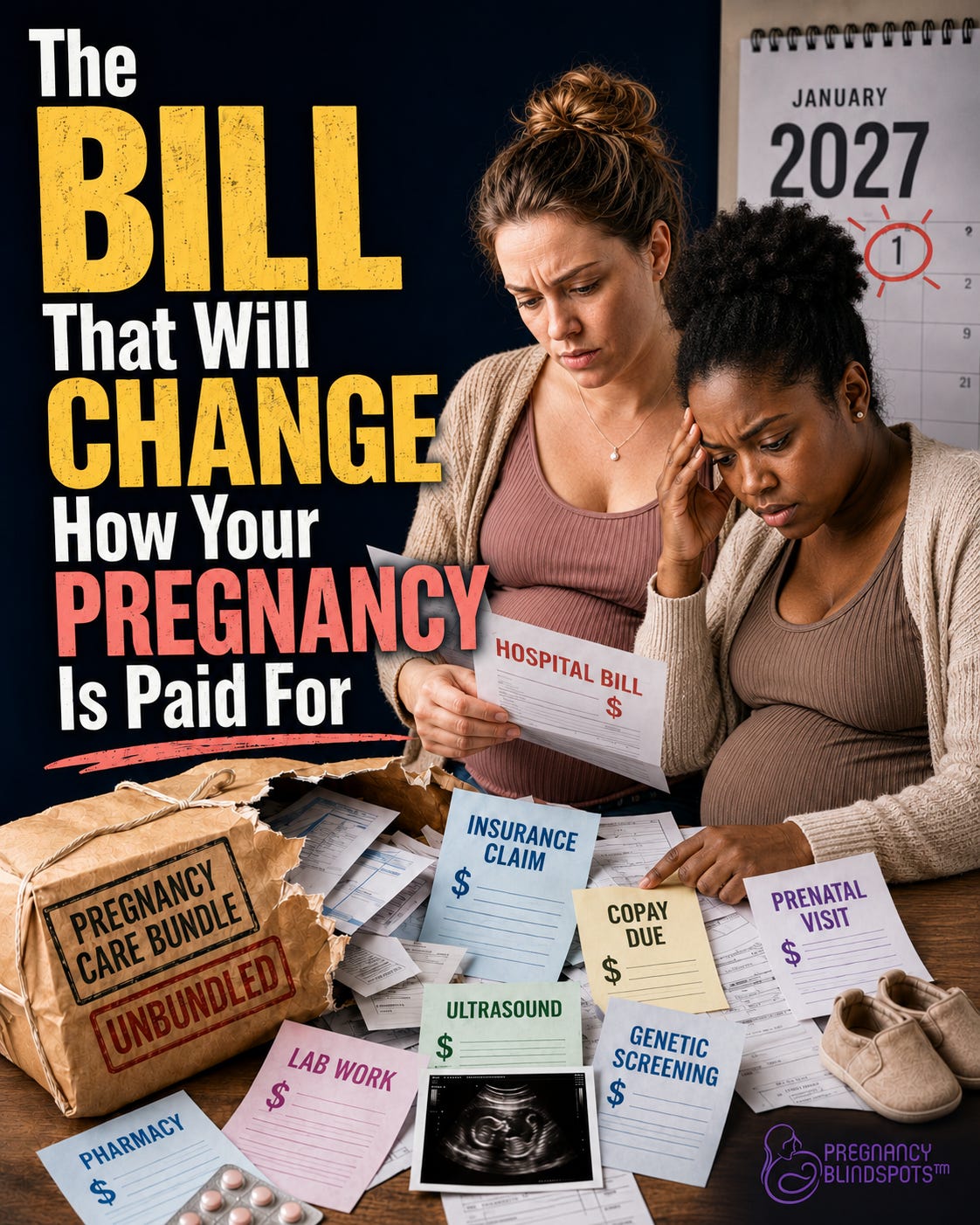
Starting January 1, 2027, the way maternity care is billed in the United States will change for the first time in 40 years. The American Medical Association and the American College of Obstetricians and Gynecologists have agreed to unbundle maternity care billing. A pilot period begins in September 2026.
As Dr. Neel Shah, Chief Medical Officer of Maven Clinic, recently discussed on the Radio Advisory podcast, national health plan leaders, independent practices, and large hospital systems are all, in his words, “on their back foot.” Nobody is fully prepared. That includes your insurance company. That includes your OB/GYN’s office. And almost certainly, it includes you.
This article is here to change that.
What “Unbundling” Actually Means for Your Wallet
Since the 1980s, your entire pregnancy has been covered by one global payment. Your insurer paid your provider a single bundled fee covering all your prenatal visits, delivery, and postpartum care. You had one predictable out-of-pocket cost spread across the whole pregnancy.
Starting in 2027, that changes. Each service has its own billing code and charge. Your anatomy ultrasound. Your glucose tolerance test. Your 28-week visit. Your 36-week visit. Your Group B strep culture. Each one becomes a separate claim. Each one generates its own bill. And depending on your plan, each one could trigger its own copay or apply separately to your deductible.
Here is a question most pregnant women have never had to ask: Do I know what my deductible is, and how much of it have I already met?
That question is about to matter a great deal.
The Insured Patient Is Not Protected From This
There is a common assumption that having insurance means being protected from unexpected costs during pregnancy. That assumption has always been partially wrong. After 2027, it will be even more so.
Consider what you actually need to know about your current plan right now, before any of this takes effect.
What is your annual deductible? That is the amount you must pay completely out of pocket before your insurance starts covering anything. A $3,000 deductible is not unusual. If your prenatal care begins in January, you could hit that deductible through the first few visits and labs alone, before your coverage meaningfully kicks in.
What are your copay requirements? Some plans charge a fixed copay per visit, such as $30 or $50, for every outpatient appointment. Under the old global bundle, that structure was simpler to predict. Under fee-for-service, if every individual service generates its own claim, some plans may apply copays more broadly.
What does your plan actually cover? Under the Affordable Care Act, maternity and newborn care are considered essential health benefits, meaning all qualified plans must cover them. But what counts as covered, at what rate, and with what cost-sharing, varies significantly by plan. Knowing the difference between your plan paying 80 percent of a service versus 60 percent, especially for specialist consultations, high-resolution ultrasounds, or postpartum follow-up, is not a detail. It is potentially thousands of dollars.
The Dual Insurance Question Nobody Is Asking
Here is something your OB’s billing office will soon need a clear answer to: if both you and your partner have health insurance, which plan pays for your maternity care?
This is called coordination of benefits, and it is more complicated than most people realize. When two plans exist, one becomes the primary payer and the other becomes the secondary payer. The rules for determining which is which depend on your specific plans, your employer, and your state. What the secondary plan will cover after the primary pays, and how that secondary coverage interacts with deductibles and out-of-pocket maximums, is not always obvious or transparent.
Under the old global bundle, this was already a source of confusion. Under unbundled fee-for-service, with more separate claims moving through multiple billing channels simultaneously, the potential for billing errors, claim denials, and unexpected balances grows significantly.
If both you and your partner carry insurance, call both plans before your due date and ask them directly: how will coordination of benefits work for my maternity care after January 2027?
The “High-Risk” Label Deserves a Closer Look
One of the stated goals of unbundling is to finally pay providers more fairly for complex pregnancies. Under the old bundle, a provider managing a pregnancy complicated by chronic hypertension, pregestational diabetes, lupus, fibroids, or a history of preterm birth received the same flat payment as one managing a straightforward first pregnancy in an otherwise healthy patient.
That was genuinely inequitable, and it deserves to be fixed.
But the label we use to describe these pregnancies, “high-risk,” deserves scrutiny. In clinical practice, the line between so-called low-risk and high-risk is not nearly as clean as that binary suggests. Blood pressure can change at 32 weeks. A patient who appeared straightforward at the first visit can develop preeclampsia, gestational diabetes, or placenta previa. Risk is not a fixed category. It is a moving target across 40 weeks.
A billing system that pays more for complexity is only an improvement if its definition of complexity is accurate, up to date, and clinically meaningful. What we do not yet know is whether the new codes will capture that clinical nuance or reward a static diagnosis at intake.
That is a question providers, payers, and policymakers need to answer before January 2027.
Why Postpartum Care Is the Hidden Casualty
One of the most underappreciated risks of this change involves what happens after delivery.
Almost 40 percent of maternal deaths occur during the postpartum period, with cardiovascular complications and hypertensive disorders accounting for a significant share. The postpartum visit is not a formality. For many women, it is the appointment that catches the blood pressure that should have been treated, the mood disorder that was dismissed as exhaustion, or the wound complication that needed early intervention.
Under the old global bundle, postpartum care was included. Under fee-for-service, it becomes a billable encounter in its own right. If a patient has met her deductible and out-of-pocket maximum by the time of delivery, that may not matter. But for patients with high-deductible plans whose pregnancies span two calendar years, a delivery in December and a postpartum visit in January means starting a brand new deductible. That postpartum visit in the new model may feel like a financial decision rather than an expected part of care.
That is not a billing technicality. That is a maternal mortality risk.
The Timing Makes Everything Harder
Unbundling alone would be challenging enough. But this change does not arrive in isolation.
Federal legislation currently moving through Congress would cut approximately $1 trillion from Medicaid over ten years, with those cuts beginning the same month this billing change takes effect. Medicaid currently covers roughly 40 percent of all births in the United States. Whatever protections Medicaid has historically provided for the most vulnerable pregnant patients will be under significant pressure at exactly the moment the billing system around them is being rebuilt from scratch.
50% of U.S. counties already have no qualified birth providers. Since 2020, 133 rural hospitals have closed their labor and delivery units or announced plans to do so. More billing codes mean more claim denials. More denials mean more practices deciding maternity care is financially unsustainable.
And the OB/GYN workforce is already under strain. Physicians are leaving medicine far earlier than in past generations, with the average retirement age dropping from 70 to 48. Current federal efforts to dismantle holistic medical school admissions policies that support a diverse physician pipeline are threatening the next generation of OB/GYNs before they even arrive. Adding billing complexity to an already depleted workforce is not a neutral policy choice.
What You Should Do Before January 2027
You do not have to wait to start protecting yourself. Here are the most important steps you can take now.
Call your insurance company to find out what your maternity coverage will look like under the new unbundled billing model. Ask specifically about your deductible, your copay structure, your out-of-network exposure, and how postpartum care will be billed.
If you and your partner both carry insurance, request a written coordination-of-benefits explanation from both plans.
If you are on Medicaid, contact your state Medicaid office now and ask whether your state has addressed the January 2027 transition. Some states will be better prepared than others.
If you are planning a pregnancy that spans 2026 and 2027, ask your provider’s billing team directly how care that begins before the change date and ends after it will be handled. That gap currently has no universal answer.
If you are a provider or health system administrator, the window to renegotiate payer contracts, update billing systems, and train staff is narrowing faster than most organizations realize.
The Larger Picture
The global payment bundle that shaped American maternity care for 40 years was imperfect. It paid the same for complexity that was not equal, making innovative technologies harder to adopt and properly compensate for. The argument for changing it is real.
But as Dr. Shah noted, the problem was not bundled payment. It was a bad bundle. And the answer to a bad bundle is a better bundle, not an experiment run on the entire population simultaneously, without a pilot, without accountability structures, and without a clear plan for who absorbs the risk when things go wrong.
What gets built between now and January 2027 will determine whether this change improves maternity care or accelerates its collapse in the communities that need it most.
That is why this conversation matters. Even when it starts with billing codes.